Showing posts with label #30DayFHWChallenge. Show all posts

Thursday, November 24, 2016

Day 21 Genealogy Challenge - Military Days


Select an ancestor who served in the military, and write a letter to him or her from the perspective of a loved one on the home front. Ask about his or her health, or the conditions in the war. Read real-life wartime letters for inspiration 
My pick for this is my 3X great grandfather Samuel Wray who was born in 1821 in Williamson County, Tennessee.  In 1849 he married Mary Ann Neal and moved to Paducah, Kentucky where he owned a general store in town. He joined Company C of the 12th Volunteer Cavalry as a bugler,  and also worked as a wagoner. I am not surprised at this. Considering his age, he was definitely older than most soldiers. The job of a bugler was not only to play taps, he played the calls to go forward and retreat and many other special calls that I will write about at a later date.A wagoner was in charge of getting supplies to the troops. That didn't keep him safe, he was injured at the Battle of Cynthiana.
                                                                                                                  March 30, 1864
Dear Sam,
                I am patiently awaiting your next letter, I know how hard it is to get mail through the lines. Things have been difficult here. The Confederate Army led by a Major Forrest came in and stole many of our horses, mules and supplies and destroyed what they didn't take. They also attacked our fort, but they were repulsed. The sad thing is we lost 90 of our brave men.
When I see things like this I have a great fear for you and your life. How do you fare and where are you? Your last letter had you in Lebanon, Kentucky, are you still there? The store is still in its rightful place despite all the fires at the dock during the siege. There were gunboats on the river shelling us with their artillery and several places in town are gone, we were mighty lucky our little store survived. 
Are you getting enough to eat? Is there sickness in your camp? Every day we hear of young soldiers dying of sickness because they are not getting enough victuals. Has this happened in your company? The children are doing well. William is a big help in the store and Annie is as well. We are so lucky to have such well behaved children Sam. 
There is not much else to report. I pray God is with you and keeps you and your fellow soldiers safe. 
With love and affection,
Mary Ann


                            Battle of Paducah as seen on the wall along the riverside in Paducah

Day 20 Genealogy Challenge - Don't Leave Home Without It!


 Write a paragraph describing three items your ancestor would never leave home without.

Alice Eleanor Swinton, my husband's grandmother, was born August 8, 1892 in Toronto, York County, Ontario, Canada.  My husband always referred to her as his Victorian grandmother because she was so well bred and well versed in etiquette.  When my mother-in-law passed away we became the proud owners of some of her things and among them were these three items. Her glasses, Bible, and her calling cards. 

These may seem small and silly to keep to some people, but it is a small testimony of who she w as. She was a teacher in a one room schoolhouse in Mindemoya on Manitoulin Island, so of course her glasses were a must. Back then, the Bible was allowed and taught in school, so she needed to bring it with her as she also read it at home. Her calling cards are a sign of a bygone era. Whenever she visited someone, especially when she lived in Wiarton on the Bruce Peninsula, she would leave her card if they weren't home. They really are the forerunners of today's business cards! I love these cards; sometimes life is so frantic today with cell phones and everything at the ready, we miss some of the subtleties and grace of earlier times.


                                                     a case for calling cards.

Day 19 Genealogy Challenge - The Berlin Wall


Identify a major event that happened in your ancestor’s lifetime and as your ancestor write a first person journal entry describing it. What would your ancestor have thought about it? What would he have found exciting or frightening?

A little background on my ancestor : Bertha Liedke (shown in this photo, back row 2nd from left in 1919) born March 19, 1900 in Nowy Witoszyn/Neuwittoschinn, Kreis Lipno, Prussia/Poland. She was born into a German family living in Poland under Russian rule. Their town was German, their schools were German and they spoke German. I had a hard time figuring this out when I was young. I kept telling my grandmother if they lived in Poland and were born in Poland, then they were Polish. She would always pitch a fit and tell me they were Germans! It wasn’t until I read the history of Poland and saw all the border changes making it German, Russian and sometimes Poland, that I understood. Bertha was my great grandmother’s younger sister. My great grandmother and one brother emigrated to America around 1905, but the rest of the family stayed put. After they married and their parents passed away, most of them left Poland and moved to Germany itself.


Dear Diary, 
      I woke up to the most astonishing sight this morning! Somehow, during the night, there has been a wall of barbed wire erected on the border between East and West Berlin! I never heard a thing and I live close enough to be able to see it from the window of my apartment. I knew there were rumors that the police were going to tighten the border, but I don't think anyone expected this! Of course everyone immediately went outside to see what had been done. Somehow they managed to tear up some of the street, dig holes and put in concrete posts and then string barbed wire all across it. Not only that, but they have cut all the telephone wires ti West Berlin. We are truly cut off from the world. My sister Augusta and her husband Robert, my brother Adolf and my sister Emma and her husband Edmund all live on the other side of the wall. Oh why didn't we leave while we had the chance? It has not been easy living here to begin with! The communist leaders have been so repressive for many years and a lot of people have gone over to the other side and not come back. It is what Emile and I should have done, but we are old and the idea of starting again with absolutely nothing just wasn't something we thought we could do. We have heard that no longer can we cross the border to see the opera, go to soccer games or plays. We are stuck here forever! Please God have mercy on us!

Tuesday, November 22, 2016

Day 18 Genealogy Challenge - Tobacco Road


Who was your ancestor’s best friend? How did they spend their time together? Write a paragraph or two about an adventure they had, real or imagined based on what you know of their childhood, time period and places they lived


Today’s ancestor will be Roy Cook, my husband’s paternal great uncle and his twin brother Coy who was his best friend for his entire life.


Roy and Coy’s family worked on a tobacco farm in Robertson County, Tennessee.  It was a hard living, but not uncommon in the very early twentieth century. Many people could not afford their own piece of land to farm, so they worked on the large farms that surrounded them. They lived in a small dirt floored cabin with their parents and 10 siblings. They were the youngest being 20 years younger than their oldest sibling. They were spoiled by all of them.


One day while they were helping their dad on the farm, they decided to see if they could swipe some of the tobacco for a smoke. What they didn’t understand at that age was that the tobacco was green and needed to be cured. They hid their big leaf under Coy’s shirt and secreted it away during their lunch break.

After dinner that night, they headed outside with some pilfered matches to get their tobacco. They rolled it into two “cigarettes” tossing the excess away and worked at getting them lit. Eventually they got a bit to smoke and puffed away feeling very grown up.

It wasn’t long before they started feeling a bit queer and stumbled home very green about the gills. Pap knew exactly what they had done as soon as he saw them and after they got their bottoms paddled, Ma got them outside quick enough before they hurled up their dinner. Never again did they try to smoke green tobacco!!


Roy and Coy never married and spent their lives being doted on by their family! Coy died in April of 1998 and Roy, lost without his twin, died in October the same year.

Sunday, November 20, 2016

Day 17 Genealogy Challenge - A Special Heirloom

     Select a family heirloom and write a narrative from its perspective. Where has it been? How did your ancestor acquire it and what would it have encountered throughout the years? What important family milestones might it have witnessed.

     You might think I am just a lowly chair, not worth very much. Surely jewelry or pottery may seem more exciting to you, but I must tell you I have had a long and rich life. I was made in Germany and was so beautiful when I was finished. Though I am made of birch and not maple, I am well made for the special treat of rocking a young one to sleep. I am covered in a mahogany finish and have mother of pearl inlaid on my back piece. My seat is contoured for giving the most comfortable fit.
 
     I was so thrilled to be brought to the new world, what an astonishing adventure being shipped across the mighty Atlantic Ocean.  When I arrived at my first home in New York, there was great excitement. A baby was about to be born. People were running to and fro to make everything ready for the tiny bundle of joy. I was put in a nice quiet room with a beautiful crib and matching chifferobe. 
     I was only alone for a few days, in fact the mother came in several times and sat in me and rocked back and forth practicing sweet songs. Finally the day arrived and a sweet girl named Hertha was born. Mother came in when little Hertha was crying and brought her over to me. She sat down and nursed the sweet babe all the while rocking gently and singing lullabies. Each day they used my special ability to soothe and calm little Hertha. Before long, Hertha was getting around on her own and a new life joined the family. Her name was Eleanor and she was just as sweet as Hertha. Mother always rocked her, just as she had Hertha, and some days Hertha came in and rocked in me all by herself. Yet another girl arrived, this one name Florence.  What a busy family we had become. Over the years as the nursery gave way to little girl's bedrooms and then young ladies bedrooms, but I still had my place in the corner of one of the rooms. Fairy tales were read whilst rocking, books from elementary school and even more grown up books as the girls entered high school.
     One day, Hertha stopped coming home. She had found a husband and moved out. Not long after, Eleanor got married too. When she found she was expecting a child, she came to her mother and asked if she could bring me to her house to rock her baby in and so my residence changed. Over the years I was pleased to be used by yet another Eleanor, Phyllis, Ethel and Robert and then I sat alone for a long time unless the new young family's came by and then I would be employed to rock grandchildren in while they were visiting. Many more years passed and sadly I was relegated to the basement and there I stayed for a long time....until one day Eleanor's daughter Linda was expecting a little bundle and asked if anyone was using me. "No, her grandmother said, would you like it?"
"Oh yes, she replied, it's just what I have been looking for." So I came up out of the basement and was put in a car and driven to the state of Illinois, but that was not my final destination, oh no! The young parents were in the process of moving to the country of Canada, so I was loaded into a moving van and taken to Bracebridge in Ontario. Amanda was born and settled right in as her mother rocked her in me. She too sang beautiful lullabies as she nursed and rocked her. Before long Tiffany arrived and I was happy to be of service.
     It was time to leave Canada and move back to the United States and I found myself once again in New York, but a terrible thing happened to me during the move. The load in the moving van shifted and my seat was broken in two. For many years I sat in a garage waiting to be fixed, but it seemed there was no time for me and a new rocking chair was brought in to help with the newest addition.
I sat there for fifteen years and then moved with them to a new town. I think they kept planning to fix me, but didn't have the wherewithal to do it. I sat in the new house's garage until one day fairly recently, I was pulled out and given to a man for repair. This man was a wonder with all things wood. I was amazed sitting in his workshop at the beautiful things he made. Finally, one day he started working on me, carefully fixing my seat and all the loose parts that I had. The family was so excited to see me back healthy and whole, because now they have grandchildren who can be rocked in me once again.
         

Day 16 Genealogy Challenge - A Fairy Tale Life


Imagine one or more of your ancestors as the characters in a fairy tale or fable. What role would they play and what is the setting? What would be your fate?

Oh gosh, this is an interesting idea....who am I going to pick and what story should I relate? I think I will pick my husband's 2X great grandfather Hugh Carrigan who was born in Ireland in 1829

Once upon a time, there was a young man of Ballyknockanor who truly had a lovely heart. Many a time he would give up his own wants or needs to help one of his countrymen.He worked very hard on his small piece of rented land and often was seen giving food to the homeless people. If a man knocked on his door and asked for a potato or something to eat, Hugh would give it to him even if it was his last potato. Now there was a great famine in the land and the potatoes the people grew were turning black and inedible. This plague was happening all over Ireland and food quickly became scarce. Poor Hugh's garden was no longer producing as it had before because the molding potatoes were affecting everything in the garden. He wept for the people dying and prayed for God to help him help his people. He took stock of all he had in his little thatched house and decided to sell all his farming tools. So he walked all the way to Dublin city with his little cart to get the best prices he could. On the way back, a light brighter than any ever seen covered Hugh and a voice came from the clouds. "I have seen what you have done Hugh Carrigan and I delight in you. From now on, all you plant will grow exceedingly so you can keep feeding the people of Ballyknockanor." Hugh hurried back to his simple cottage and took the remaining seeds and potatoes he had tucked away and planted them. The plants flourished  and he was able to give oats and grain and potatoes to the people of his town. This is why Ballyknockanor made it through the years of the famine.

The moral of this story is if you give selflessly and keep God in all you do, he will hear your cries and answer them.

Friday, November 18, 2016

Day 15 Genealogy Challenge - What in the World??


Today's challenge is really interesting - Pick an ancestor from the 1800's and drop him/her into today and as your ancestor write a letter to family members back in the 1800's. How would he describe today? What surprises him? What questions would he have?


Dear Mary Ann,
                           Holy cow! I don't know what happened but I seem to have been transported in time to a strange place. I think its Nashville, I recognize the courthouse, but everything is so different! The streets are mostly the same, but the houses are so different. I went by our home only to find the lot is empty and a huge building next door. Our lot has some black substance on it that is very hard and there are what I can only call horse-free carriages parked all over it. The buildings I see are so tall I cannot imagine how someone climbed up to build them. They must use some sort of engine to lift the workers up while they are building them.
     I am absolutely shocked by the clothing people are wearing. Some of the men have shirts with vulgar sayings on them and dungarees, but the dungarees have holes in them and I can't imagine why they would wear them in public. I see young men with their pants on their thighs with their underwear showing - why in the world would they do this? How can they run with their pants hanging down like that? There are also business men wearing suits but they carry this device they speak into and use their fingers to make it do other things. I see a lot of people with these things. No one is paying attention to one another and sometimes I see them walk right onto the street without looking up. How foolish are these people? If one of those horse-free carriages comes along, they are bound to be hit!
The ladies ( if I can even call them that) are even worse! They have no decorum, they look like ladies of the night. Some wear tops that show their stomach or their bosom and wear their pants so low I am afraid to look! They are not wearing a camisole, but wearing what looks like undergarments on the outside. How can they look at  themselves dressed like this? They too carry that device I spoke of even when with friends. No one is talking to their companions, they are too consumed by this device.
I do not see any horses around, but there is a strange contraption that flies through the air. It makes me think of some of the prophecies in the Bible. I don't understand how something so big can float in the sky.
     I have gone to a few of the stores. There are so many things to buy. How could you possibly need all these things? They have handyman stores that are so big and sell so many things you could spend days looking at everything. They even have something called a mall which has dozens of stores all under one roof. There is a hotel called the Gaylord that is nothing short of amazing! It has windows even on top of the building so you can see the sky, but you are kept out of the weather.

One thing that is curious is that I don't see children playing outside with each other - even they have the devices I mentioned earlier. There are so many people who are overweight, not by a little Mary Ann, but very big people. I think it must be because of that darned device, it keeps people from doing things that are healthy. I see people running places, but I think not having to do things by hand keeps many of the people from doing work that is good for them.
I have been going to church and it is very different from ours. They do not sing our beautiful hymns any more. Instead they have electrified guitars and drums and people who lead the singing of songs that are very repetitive. I don't think there is much to the words and I wonder why they felt the need to take away our thoughtful hymns. I see some of the churches don't have very many people, don't people believe in God anymore? That surely worries me.
There are some things I like about this world, certainly indoor toilets and bathtubs with water that you don't have to haul in and warm on the stove is very nice! Some of the foods are from other countries and actually quite nice to taste. My bed is wonderful and soft, I feel like I am in a dream and perhaps I am. I miss you and the children so much and I pray I find a way back to you. I love you Mary Ann.
Love
Sam

Day 14 Genealogy Challenge - Journey to Canada

Write a diary or journey entry that details your immigrant ancestor's journey. What are their impressions of their fellow passengers. Research passenger lists and ships documents to make your description more accurate. I have picked my 3X great grandmother Johanna Stanton Driscol who was from Skibbereen, West Cork, Ireland. She left Ireland in 1846 in the height of the potato famine.

Dear Diary,
I fear this journey will kill me! We have been on this ship for almost a month now and I am so hungry and dirty. There is sickness and fever everywhere on this boat. We are jammed together having maybe six feet by 18 inches total to ourselves in which to sleep and eat. The bunks are 6x6 but we sleep four to a bunk and I was lucky that my mother and father and two brothers are also aboard so I don't have to share my bunk with strangers. I hear we started with 300 aboard in a boat that is only supposed to hold 150. We had to bring our own food for the voyage and there are now weevils and maggots in it. We still eat it because we won't survive if we have no nourishment. We are given 2 pints of water a day, but it is often fetid and I fear some of what is making us so sick. There is a slop bucket in a corner where we relieve ourselves, but it often gets tipped over when the boat hits rough weather and there is typhoid fever and dysentery on board. Every day there are people dying and I worry about my husband Denis who has become ill this day. People are sick in their bunks and the vomit is dripping down to the bunk underneath.They call these ships coffin ships and now I know why. We left Skibbereen because we were starving there. Thousands are dying from the potato famine and we felt the only way we could survive was to buy passage on a ship to Canada. The tickets were less expensive than buying one for America and it took all we had. We each brought a small bundle of clothes which was basically all we had left after selling what little we had for tickets. I hear once we are there, it will be easy to get into America and that is our plan. I pray we all make it!


Day 13 Genealogy Challenge - A Wedding


 Describe an ancestor's wedding.Study marriage certificates, wedding banns and photos, clothing and rituals to fill in details.

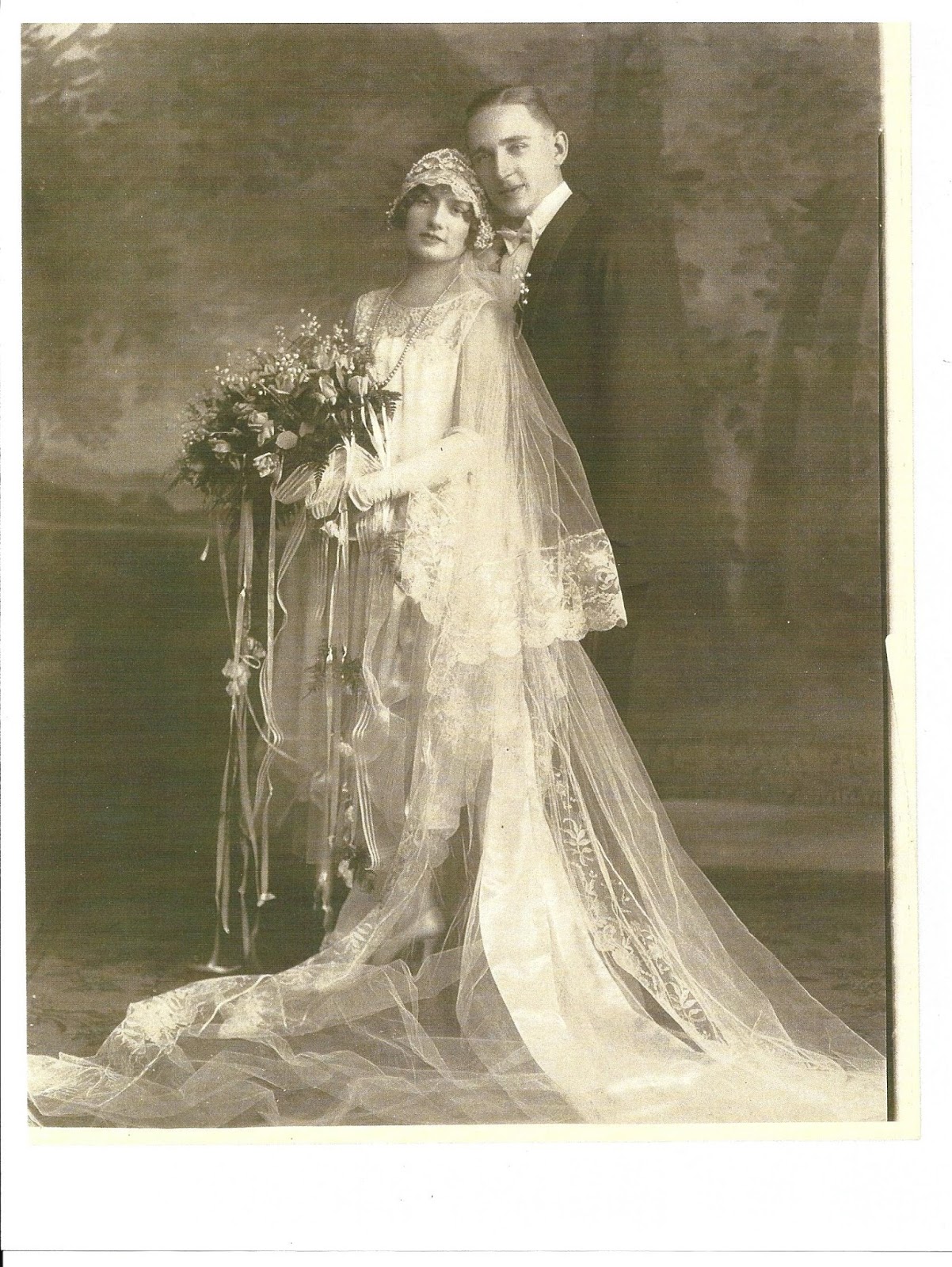
I am choosing my dad's parents for this, mainly because of the lovely wedding pictures!
Mabel Nancy Schloman, daughter of Henry Garry Schloman and Lillian Schneider married Albert August Miller who was  the son of August Miller and Karolina Amelia Barie. Both were born in New York City and eventually moved to the Bronx. I am not certain how they met,  and that is a pity, (it is why you should ask questions of your family now while they are still here!) I know lots of little stories about each of them, but not their love story)

Suffice it to say they fell in love in the mid 1920's and married in 1928. They were Lutheran as they were German, so there was no need for banns to be read. I do have many photos of them sharing days and outings with their families so I suspect there was a lot of group dating going on - safety in numbers as they say!

Mabel came from a small family. She only had one sister named Edna. Al was from a larger family having sisters Marie, Margaret and Augusta and a brother Carl.

I love this picture - the beautiful gown she wore and the large bouquet of flowers with the streaming ribbons are so indicative of fashion in that time. Her sister Edna, maid of honor sits next Albert, while his brother Carl,  the best man sits to Mabel's right. I know one of Al's sisters, I believe Augusta is behind Albert, I am not sure if the other woman is related somehow to Mabel but her facial structure is similar!
 Being German, I imagine the wedding was full of polkas, lots of beer (August was a brewer) and German songs like Ein Prosit (A toast, a toast, to cheer and good times)and certainly the song Du, Du Liegst im Herzen (you, you are in my heart). There would surely be traditional customs.
After the ceremony, the bride and groom would saw a log in half to symbolize overcoming life’s tough challenges together and the guests would throw rice at the couple. It is said that whatever amount stays in the bride’s hair is the number of children the couple will have.

I do have to share one story - when Al and Mabel came home from their honeymoon, they found their friends had spread limburger cheese on their radiator and they spent the night cleaning it off! 

Thursday, November 10, 2016

Day 9 - Describe and Ancestor's City

                                                          Nashville 1880  

The challenge for today is to pick an ancestor's home town and do some research on how it was during your ancestor's time. Use historical pictures, post cards and city directories to learn about the town, then write a brief tourism ad for the locale highlighting the town's attractions.  
I picked Nashville, Tennessee in the year 1880 when my 2 and 3X great grandfather's lived there. The centennial means a lot to me personally as it was the celebration of the signing of the Cumberland Compact. My Wray/Ray ancestors signed it and were among the first to settle Nashville in 1780.

    In 1880 the Tennessee Centennial Exposition was in full swing. It marked the hundred years of progress since the founding of Nashville and thousands of people flocked to the centennial grounds for the festivities.

Come to Nashville for the Centennial Exposition! Starting April 23 and running until May 29, it is the place to be! There will be parades, orators, music, historical art and commercial exhibits. You will enjoy theatrical performances and the grandest display of fireworks ever seen in Nashville! The exposition is at Broadway and 8th Avenue North, right in the center of our bustling city. In addition to the centennial there is much to see and do here. We have some wonderful buildings including the state capital, city hall and the court house. You can shop and find a little bit of everything in the Market Square, and enjoy a spring evening walk along the Cumberland River!

Monday, November 7, 2016

Day 7 Genealogy Challenge - Across the Centuries


SO, the idea today is to select two ancestors who lived in different centuries and describe a scene of the two interacting with each other. What did they talk about, how are they different from one another?

     I have chosen Caleb W. Lemons born 1819 and Robert Lemons born 1926. Caleb was the first in his family to be born in Tennessee and Robert was the last born there.

     I don't know a lot about Caleb other than what I find in the census and some court records. He was a farmer, very involved in his community of Gainesville in Jackson County, TN. Robert was born in Nashville, Davidson County, TN: I know a lot about him as he was my father-in-law and I have done a lot of research about his life.

     Caleb would tell Robert that his great grandfather came to America from Dover, England as an indentured servant looking for a better life. Life was hard for the poor in England and making this trip was the only way his great grandfather could get a leg up in the world. He would tell him that he was the first born in Tennessee and that life was never easy. He would tell him to always be honest and forthright, to be a good neighbor, love the Lord and always dream big no matter the circumstances.

   Robert would say, "But my life has been so difficult, sometimes I can't even figure how I will make my way in the world. My dad is in jail and my mother doesn't take good care of me. Half the time I live on the streets until Child Welfare catches up with me and makes me go to the Tennessee Industrial School. I hate it there! I don't have any friends and they work us like slaves. I don't understand why I had to be born into this family; why couldn't I have been born into a good family that cares about me!" "Oh, Robert, when I was young, the family was just that.We were a good family and my son Samuel was a good man. His son John was also a good man and well loved in his community, but he died from a cold he caught that turned into pneumonia. Drugs weren't easily gotten in those days and he died. He was only 36 years old. He and his wife MaryBeth (Bowen)  had several children - James Blanchard 11, Mary Jane 6, your father Albert Lee 5 and Mattie Valentine who was only 2 months old when it happened. Life became twice as hard for MaryBeth who worked as a laundress and she fell apart and wasn't taking care of her children. The state stepped in when he was 13 and took Mary Jane and Albert and put them into the same school you hate so much. It made your dad an angry young man and instead of drawing strength from God to get through the difficult times, he fell into a life of crime. Your mom was a girl who didn't like rules, so he appealed to her. They never should have married, but still, because they did, you are here and you have some choices to make. Choose good over evil, find a way to live on your own - maybe join the service, it will give you discipline which you need. Make something of yourself, the world is yours to conquer - go out and do just that!' These are the best things I can tell you Robert. No one is born a thief, no parent ever looks at his or her baby and says ,"Oh! I hope they grow up to be criminals!" It is all about choices, please make the right ones."
     "Wow! I had no idea about any of these things! So much of it makes sense to me now. Thank you so much for giving me clear words of direction. I promise to take them to heart and make you proud. I will be like my grandfather John and make something of myself."

     As a side note, Robert did eventually find a home in his teens with a caring family who took him in to help with farm work. He joined the Navy in World War II and when he came back, worked until he put enough money by to start his own business. He was a successful painter and decorator, very involved in his church and Lion's  Club and was well loved by his community. When he died, his family heard many stories of his helping people who fell on hard times. He used his own hard times to learn to care for others.